
 English
  Chinese
What Is Air Compression Therapy? A Practical Guide for Circulation Support and Recovery Care
This FOFO Medical guide helps medical device buyers, distributors, rehabilitation centers, and home-care providers understand how air compression therapy systems work, where they are used, how to compare device types, and what certifications to check before sourcing compression therapy equipment.
Contents
- 1 Quick Summary
- 2 What Is Air Compression Therapy?
- 3 How Sequential Air Compression Works
- 4 Common Applications in Circulation Support and Recovery Care
- 5 Upper Limb, Lower Limb, and Waist Compression Therapy: What Is the Difference?
- 6 How to Choose the Right Air Compression Therapy Device
- 7 Common Mistakes Buyers Make When Selecting Compression Therapy Equipment
- 8 FOFO Medical Certification and Compliance Support
- 9 Recommended Air Compression Therapy Solutions from FOFO Medical
- 10 Buyer Recommendation: How to Match Product Type with Market Demand
- 11 FAQ
- 11.0.1 1. What is air compression therapy used for?
- 11.0.2 2. How does an air compression therapy system work?
- 11.0.3 3. Is air compression therapy suitable for home-care use?
- 11.0.4 4. What is the difference between a medical compression therapy device and a leg massager?
- 11.0.5 5. Why are certifications important when buying air compression therapy equipment?
- 11.0.6 6. Which type of air compression therapy device is best for lower limb edema care?
- 11.0.7 7. Are wireless battery-operated air compression devices better?
- 11.0.8 8. Why choose FOFO Medical as an air compression therapy supplier?
- 12 Final Recommendation
Quick Summary
Air compression therapy uses controlled sequential inflation to apply gentle pressure to the limbs or waist, helping support blood circulation, lymphatic return, swelling management, and recovery comfort. For hospitals, rehabilitation centers, home-care distributors, and medical device buyers, the right system should be selected based on treatment area, pressure control, portability, chamber design, safety certifications, and intended use.
Air compression therapy has become one of the most practical recovery-support technologies for clinics, rehabilitation centers, elderly-care facilities, sports recovery rooms, and home-care users. Instead of relying only on manual massage or static compression garments, an air compression therapy system uses inflatable chambers to create repeated pressure cycles around the arm, leg, or waist. The goal is simple but important: support circulation, encourage lymphatic return, help manage swelling, and improve comfort during recovery care.
For B2B buyers, however, the question is not only “Does it work?” The more important question is: “Which type of compression therapy device is suitable for my market, my users, my regulatory requirements, and my after-sales risk?” Choosing the wrong system may lead to poor user experience, product returns, compliance delays, weak distributor confidence, or limited access to hospital and clinical channels. In medical equipment sourcing, the cheapest product is rarely the safest decision. Tiny price savings can become very loud when customs, registration, or customer complaints arrive at the door.
This guide explains how air compression therapy works, where it is commonly used, how different product types compare, what mistakes buyers should avoid, and why certification support is especially important when selecting a reliable medical compression device supplier.
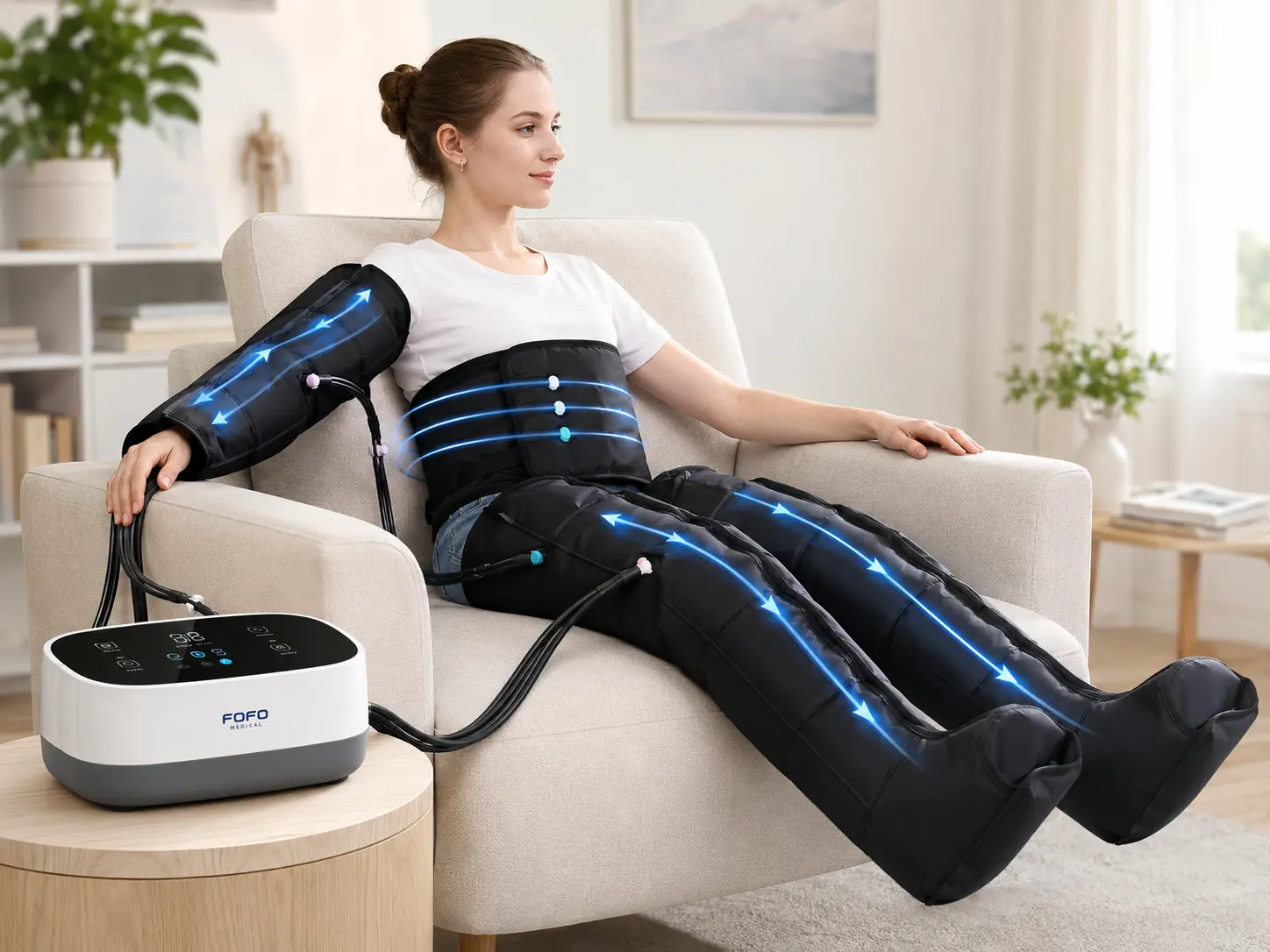
A professional air compression therapy system used for circulation support, swelling management, and recovery comfort in home-care and clinical environments.
What Is Air Compression Therapy?
Air compression therapy, also known as pneumatic compression therapy or sequential compression therapy, is a non-invasive support method that uses air pressure to gently compress targeted body areas. A pump or controller inflates and deflates multiple air chambers inside sleeves, boots, wraps, or cuffs. These pressure cycles can help promote venous and lymphatic return, especially in the limbs where swelling, fatigue, or poor circulation may occur.
In practical use, air compression therapy systems are often designed for the upper limbs, lower limbs, waist, or full-leg recovery. Some models focus on clinical rehabilitation, while others are designed for home-care comfort, sports recovery, or daily relaxation. The device does not replace professional diagnosis or medical treatment, but it can be a valuable recovery-support tool when used according to professional guidance and product instructions.
For buyers, this distinction matters. A product positioned for medical recovery support needs stronger compliance documentation, clearer pressure control, and more reliable safety testing. A comfort-focused leg massager may be easier to sell in wellness channels, but it should not be marketed with exaggerated treatment claims. Good positioning protects both the supplier and the distributor.
How Sequential Air Compression Works
The working principle of air compression therapy is based on controlled inflation and deflation. In a typical sequential system, air chambers inflate one after another from the distal area toward the central body direction. For example, a leg compression boot may start from the foot and move upward toward the thigh. An arm sleeve may inflate from the hand toward the shoulder. This sequential pattern is designed to imitate the natural muscle pump action that helps move blood and lymphatic fluid back toward the heart.
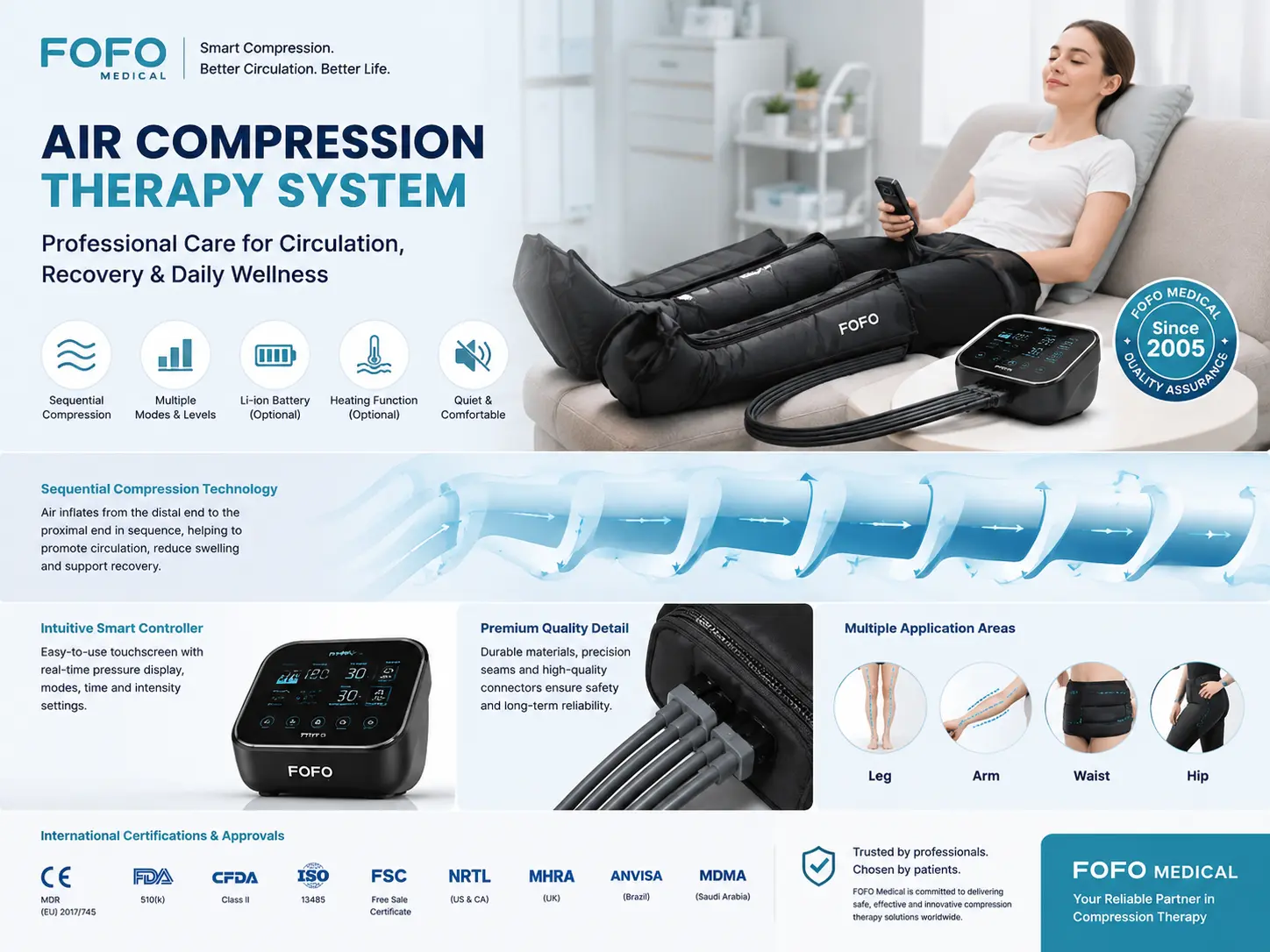
FOFO Medical air compression therapy system with sequential compression technology, smart controller design, multiple application areas, and international certification support.
| Working Stage | What Happens | Buyer-Focused Value |
|---|---|---|
| Inflation | Air chambers inflate in a controlled sequence around the limb or waist. | Creates a consistent compression cycle without manual operation. |
| Compression | Gentle pressure is applied to support circulation and lymphatic movement. | Helps improve user comfort and supports recovery-care programs. |
| Release | The chambers deflate to reduce pressure and allow a recovery interval. | Improves comfort and reduces the risk of overly constant pressure. |
| Cycle Repeat | The system repeats the inflation and release process according to the selected mode. | Allows repeatable sessions for clinics, home-care users, and recovery centers. |
This is why chamber design, pressure stability, timing control, sleeve comfort, and pump reliability are important. A device may look simple from the outside, but poor internal control can cause uneven compression, weak user comfort, or inconsistent therapy experience. For distributors, these issues often appear later as complaints, returns, or poor repurchase rates.
Common Applications in Circulation Support and Recovery Care
Air compression therapy systems are commonly used in recovery-care environments where users need circulation support, swelling management, or muscle comfort. Depending on the design and intended use, they may be used for lower limb edema care, post-surgery recovery support, prolonged sitting or standing fatigue, sports recovery, shoulder and arm recovery, waist comfort, or general relaxation.
For clinical buyers, the main value is repeatability. A properly designed air compression therapy device can provide consistent compression cycles across many users and sessions. For home-care distributors, the main value is convenience. Users can follow guided settings at home without requiring manual massage every time. For rehabilitation centers, the value sits between these two: professional recovery support with better operational efficiency.
| Application Scenario | Common User Need | Recommended Product Direction |
|---|---|---|
| Lower limb edema care | Swelling, fluid retention, poor lower-limb circulation support | air compression leg massager boots |
| Home-care recovery | Convenient daily use, flexible movement, simple operation | wireless battery operated air compression device |
| Portable clinical or home use | Battery operation, mobility, reduced cable limitation | lithium battery air compression therapy system |
| Comfort and warming support | Leg relaxation, warmth, comfort-focused recovery | air compression leg massager with heating |
| Daily relaxation channel | Comfort, fatigue relief, home wellness positioning | leg massager for relaxation and comfort |
Upper Limb, Lower Limb, and Waist Compression Therapy: What Is the Difference?
Different body areas require different sleeve structures and pressure logic. A lower limb compression boot cannot simply be treated as the same product as an upper limb sleeve. The anatomy, use posture, comfort requirement, and recovery purpose are different. This is where many buyers make their first mistake: they source one popular model and try to sell it into every channel. That approach may work for low-value products, but it is risky for medical and recovery equipment.
Upper Limb Air Compression Therapy
Upper limb air compression therapy is designed for the arm, shoulder, and hand area. It may be used in recovery-care settings where users need support for swelling management, circulation, stiffness, or mobility comfort. The sleeve should fit the upper limb properly and provide controlled compression from the hand toward the shoulder.
For B2B buyers, upper limb systems are more suitable when your customers include rehabilitation departments, post-surgery recovery centers, physical therapy clinics, or home-care providers serving users with arm-related recovery needs. If your market focuses mainly on leg fatigue or lifestyle relaxation, upper limb models may be a secondary product rather than the main sales driver.
Lower Limb Air Compression Therapy
Lower limb air compression therapy is one of the most common categories because leg swelling, poor circulation support, prolonged sitting fatigue, and sports recovery are widely recognized needs. A lower limb system usually uses boot-style sleeves that cover the foot, calf, and sometimes the thigh. Sequential compression can help support venous and lymphatic return in the lower limbs.
If your customers include elderly-care facilities, wellness retailers, sports recovery centers, home-care distributors, or rehabilitation clinics, lower limb systems are often easier to explain and easier to sell. However, the competition is also stronger, which means certification, product reliability, pressure control, and comfort design become more important differentiators.
Waist Compression Therapy Wrap
Waist compression therapy wraps are designed for the lower back and waist area. They focus more on comfort, muscle relaxation, blood circulation support, and recovery-care convenience. Compared with limb compression systems, waist wraps need better ergonomic fit and skin-friendly materials because they stay close to the body during seated or resting use.
For buyers targeting home-care, elderly-care, office wellness, or post-recovery comfort channels, waist compression wraps can be a valuable extension. They are not always the first product in a medical compression catalog, but they help build a broader recovery-care product line.
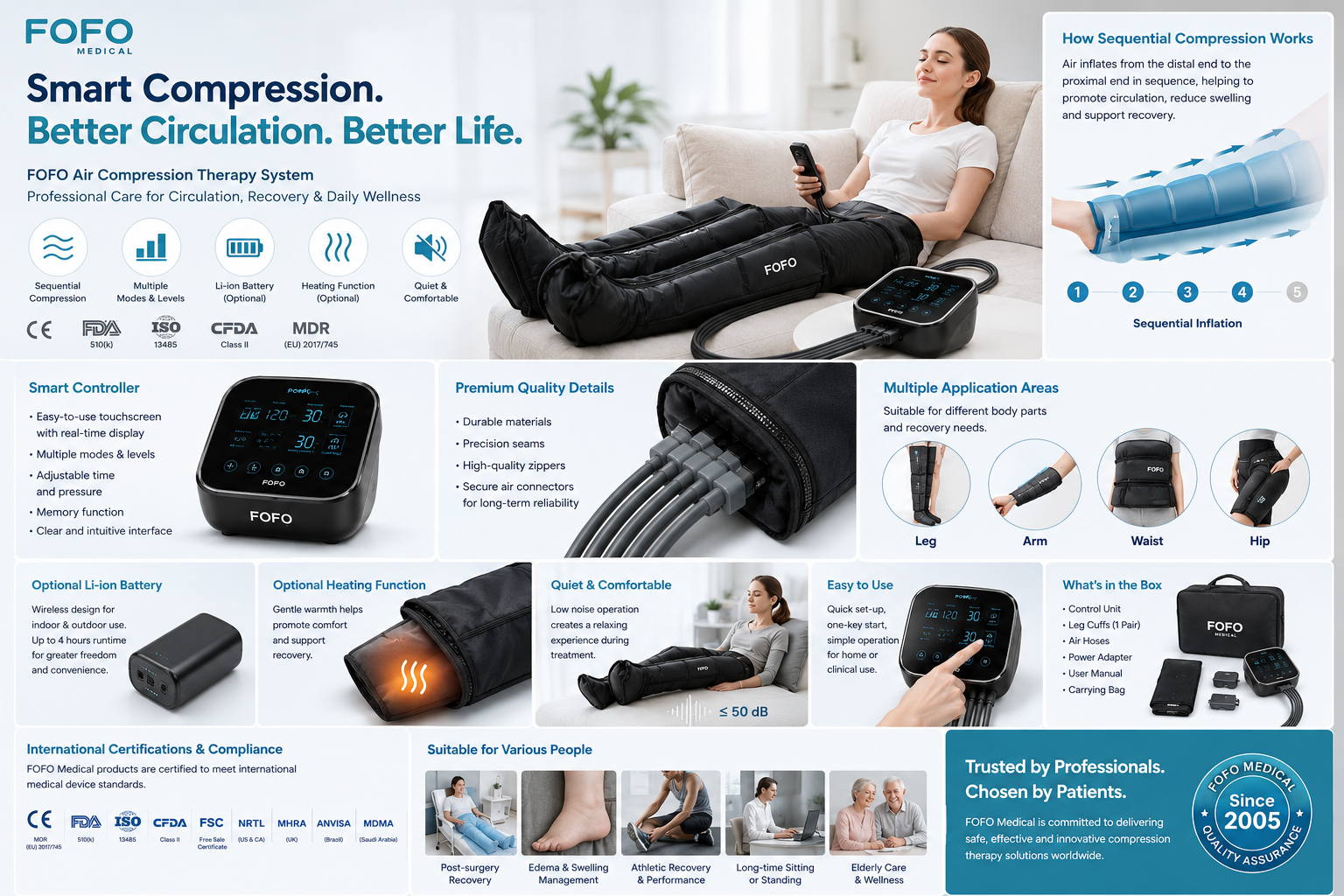
FOFO Air Compression Therapy System feature infographic showing sequential compression, smart controller, optional Li-ion battery, heating function, application areas, and international compliance support.
How to Choose the Right Air Compression Therapy Device
A good air compression therapy device should not be chosen only by appearance. Buyers should evaluate the product from five practical angles: intended use, compression design, portability, comfort, and compliance support. When these factors are ignored, the product may look attractive in a catalog but perform poorly in the real market.
| Buyer Situation | Better Choice | Reason |
|---|---|---|
| Your market focuses on clinical recovery and rehabilitation | Medical-positioned air compression therapy system | Requires stronger compliance documents, stable pressure control, and professional usability. |
| Your customers want home-care convenience | Wireless or lithium battery model | Battery operation improves flexibility and reduces cable restrictions. |
| Your channel sells wellness and relaxation products | Comfort-focused leg massager | Easier consumer education and broader daily-use appeal. |
| Your customers need added warmth and comfort | Air compression leg massager with heating | Heating function adds comfort value, especially for relaxation and recovery support. |
| Your market requires hospital or insurance-related access | Products with NRTL and medical testing support | Compliance documents can reduce registration and market-entry barriers. |
A simple rule works well: if the product is intended for hospitals, rehabilitation centers, or medical distributors, prioritize compliance and technical stability first. If the product is intended for home wellness, prioritize comfort, usability, and simple instructions. If the product is intended for cross-border distribution, prioritize documentation support before price negotiation. Price matters, but compliance decides whether you can sell at all.
Common Mistakes Buyers Make When Selecting Compression Therapy Equipment
The first mistake is focusing only on price. In medical and recovery equipment sourcing, low price without stable compliance support can create serious downstream problems. A cheaper device may become expensive if it lacks documentation for customs clearance, local registration, hospital entry, or distributor due diligence.
The second mistake is confusing wellness massage products with medical compression therapy systems. A comfort leg massager may be suitable for relaxation and fatigue support, but it should not be marketed with clinical claims unless the product classification, registration, and documentation support that positioning. Overclaiming can expose distributors to regulatory risk and customer complaints.
The third mistake is ignoring pressure control and chamber design. Users may not understand technical details, but they quickly feel discomfort if compression is uneven, too weak, too strong, or poorly timed. For distributors, poor comfort becomes bad reviews. For clinics, inconsistent performance becomes operational risk.
The fourth mistake is forgetting after-sales practicality. Sleeves, hoses, connectors, batteries, pumps, and controllers should be evaluated as a system. If spare parts are difficult to obtain or the structure is not service-friendly, long-term customer satisfaction will suffer.
The fifth mistake is using the same product for every market. The EU, U.S., UK, Brazil, Saudi Arabia, and China may all require different documentation, registration pathways, and compliance language. A supplier with stronger certification support can help buyers reduce market-entry uncertainty.
FOFO Medical Certification and Compliance Support
For B2B medical device buyers, certification is not decoration. It is market access, distributor confidence, and risk control. FOFO Medical has built a certification and testing foundation to support customers in different markets, including Europe, the United States, the United Kingdom, China, Brazil, Saudi Arabia, and other export destinations.
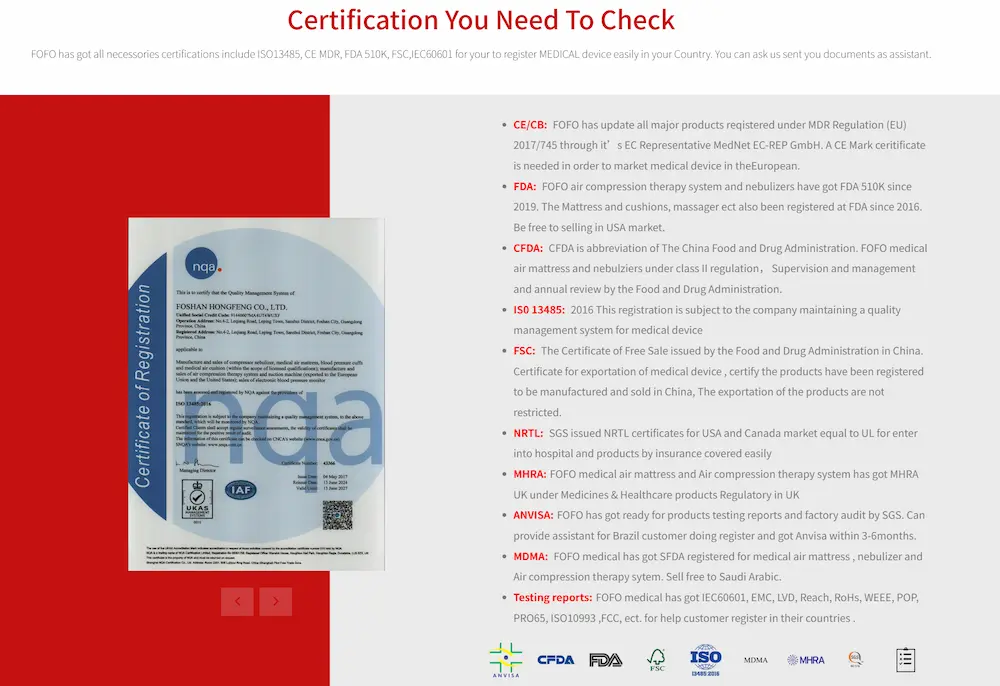
FOFO Medical provides certification and compliance support for air compression therapy systems, including CE, FDA 510K, ISO 13485, FSC, NRTL, MHRA, ANVISA, MDMA, and related testing reports.
| Certification / Registration | FOFO Medical Support | Buyer Value |
|---|---|---|
| CE / MDR | FOFO major products are registered under MDR Regulation (EU) 2017/745 through its EC Representative, MedNet EC-REP GmbH. | Supports medical device market access in the European market. |
| FDA 510(k) | FOFO air compression therapy systems and nebulizers have obtained FDA 510(k) clearance since 2019. Mattresses, cushions, massagers, and related products have also been registered with FDA since 2016. | Supports selling and distribution in the U.S. market with stronger regulatory confidence. |
| CFDA | FOFO medical air mattresses and nebulizers are regulated as Class II products under China Food and Drug Administration supervision and annual review. | Demonstrates domestic manufacturing and regulatory control in China. |
| ISO 13485:2016 | FOFO maintains an ISO 13485:2016 quality management system for medical devices. | Shows structured quality management for medical device production. |
| FSC | FOFO holds a Certificate of Free Sale issued by the Food and Drug Administration in China. | Supports export documentation and proves products are registered for manufacturing and sale in China. |
| NRTL | SGS has issued NRTL certificates for the U.S. and Canadian markets. | Helps support hospital access and insurance-related procurement requirements. |
| MHRA | FOFO medical air mattresses and air compression therapy systems are registered with MHRA in the UK. | Supports UK market entry and buyer confidence. |
| ANVISA Support | FOFO has prepared product testing reports and factory audit support by SGS, and can assist Brazil customers with ANVISA registration within an estimated 3–6 months. | Helps reduce registration uncertainty for Brazil distributors. |
| MDMA / SFDA | FOFO Medical has obtained SFDA registration for medical air mattresses, nebulizers, and air compression therapy systems. | Supports access to Saudi Arabia and related Middle East channels. |
| Testing Reports | FOFO can provide IEC60601, EMC, LVD, REACH, RoHS, WEEE, POP, PRO65, ISO10993, FCC, and related testing reports. | Helps customers prepare local registration and compliance submissions. |
This compliance foundation is especially important for medical device importers and distributors. A supplier with strong documentation can shorten communication cycles, support registration work, and improve buyer confidence during procurement evaluation. In simple words: documents do not make the product prettier, but they make the deal safer.
Recommended Air Compression Therapy Solutions from FOFO Medical
FOFO Medical offers several air compression therapy and leg massager solutions for different recovery, comfort, and distribution needs. Buyers can select the product direction according to target users, application scenarios, and market positioning.
Lithium Battery Air Compression Therapy System
The lithium battery air compression therapy system is suitable for buyers who need a more portable compression therapy solution. Compared with plug-in-only models, a lithium battery design improves mobility and makes the device easier to use in home-care, bedside, recovery-room, or flexible treatment environments.
This type is especially suitable for distributors serving home-care users, elderly-care facilities, rehabilitation centers, and mobile therapy scenarios. If users dislike cable restrictions, a battery-powered model can improve acceptance and session convenience.
Wireless Battery Operated Air Compression Device
The wireless battery operated air compression device is designed for flexible use and cleaner operation. Wireless design can reduce the inconvenience caused by tubes or cables around the user, making it attractive for home-care and wellness channels.
For B2B buyers, the main advantage is user experience. A product that is easy to wear, easy to operate, and easy to store is more likely to receive repeat use. In consumer-facing channels, convenience is not a small detail; it is often the difference between “used daily” and “left in the box.”
Air Compression Leg Massager Boots
The air compression leg massager boots are suitable for lower-limb circulation support, edema-care support, post-activity recovery, and daily leg comfort. Boot-style designs are easy for users to understand and easy for distributors to demonstrate.
This product direction is suitable for rehabilitation clinics, elderly-care channels, sports recovery centers, home-care stores, and wellness equipment distributors. If your market has strong demand for leg swelling management, prolonged standing fatigue, or lower-limb comfort, this category should be a priority.
Air Compression Leg Massager with Heating
The air compression leg massager with heating combines compression cycles with warmth for improved comfort. Heating does not replace clinical treatment, but it can enhance the relaxation experience and make the product more attractive for daily recovery and wellness use.
This type is well suited for consumer wellness channels, home-care distributors, elderly-care products, and relaxation-focused product lines. If your buyers want a product that feels more comfortable and marketable, the heating function can add strong perceived value.
Leg Massager for Relaxation and Comfort
The leg massager for relaxation and comfort is better suited for buyers targeting general wellness, daily fatigue relief, and home relaxation. It can be positioned for users who spend long hours standing, sitting, traveling, or exercising.
This product direction is easier to promote in retail and e-commerce channels because the value proposition is straightforward: comfort, relaxation, and daily leg care. The key is to avoid over-medical claims and present it as a supportive comfort device.
Buyer Recommendation: How to Match Product Type with Market Demand
If your target market is hospitals, rehabilitation centers, and professional medical distributors, prioritize certified air compression therapy systems with strong documentation, stable pressure control, and clear product classification. These buyers care less about flashy design and more about regulatory confidence, service reliability, and clinical workflow compatibility.
If your target market is home-care and elderly-care distribution, choose battery-operated or wireless designs. These users value simple operation, safe daily use, lightweight handling, and comfortable sleeves. A product that is technically strong but difficult to wear may fail in the home-care market.
If your target market is sports recovery, wellness, and relaxation, leg massager boots or heating compression models may be more suitable. These products are easier to explain, easier to demonstrate, and easier to sell through online channels, retail stores, wellness centers, and physiotherapy accessory lines.
If your target market requires registration support, do not choose by price first. Ask for CE, FDA, ISO 13485, NRTL, MHRA, IEC60601, EMC, ISO10993, and other relevant documents before making a purchasing decision. A strong document package can save weeks or months of communication later.
FAQ
1. What is air compression therapy used for?
Air compression therapy is used to support blood circulation, lymphatic return, swelling management, muscle comfort, and recovery care. It is commonly applied to the legs, arms, or waist depending on the device design. It should be used according to product instructions and professional medical guidance when needed.
2. How does an air compression therapy system work?
An air compression therapy system uses a controller and inflatable chambers to apply sequential pressure to the target area. The chambers inflate, compress, release, and repeat the cycle to support circulation and fluid movement. Different models may offer different pressure levels, modes, sleeves, and treatment areas.
3. Is air compression therapy suitable for home-care use?
Yes, many air compression therapy devices are designed for home-care use, especially wireless and battery-operated models. Home-care buyers should choose products that are easy to wear, simple to operate, comfortable, and supported by reliable safety documentation. Users with medical conditions should consult a healthcare professional before use.
4. What is the difference between a medical compression therapy device and a leg massager?
A medical compression therapy device is usually positioned for recovery support and may require stronger regulatory documentation, pressure control, and safety testing. A leg massager is often positioned for relaxation and comfort. Buyers should avoid marketing a comfort-focused massager with unsupported medical claims.
5. Why are certifications important when buying air compression therapy equipment?
Certifications and testing reports help buyers evaluate product safety, regulatory readiness, and market access. Documents such as CE, FDA 510(k), ISO 13485, NRTL, MHRA, IEC60601, EMC, and ISO10993 can support distributor confidence and local registration work.
6. Which type of air compression therapy device is best for lower limb edema care?
For lower limb edema-care support, boot-style air compression therapy systems are commonly selected because they cover the foot, calf, and sometimes the thigh. Buyers should evaluate chamber design, pressure control, comfort, and compliance documentation before ordering.
7. Are wireless battery-operated air compression devices better?
Wireless battery-operated air compression devices are better for users who need mobility, convenience, and fewer cable restrictions. They are especially useful for home-care, bedside use, and flexible recovery environments. However, buyers should also check battery performance, charging safety, and after-sales support.
8. Why choose FOFO Medical as an air compression therapy supplier?
FOFO Medical provides air compression therapy systems and related recovery-care products with strong certification and testing support, including CE/MDR, FDA 510(k), ISO 13485:2016, NRTL, MHRA, CFDA, FSC, and multiple testing reports. This helps B2B buyers reduce compliance uncertainty and build stronger market confidence.
Final Recommendation
Air compression therapy is most valuable when the device matches the user scenario, market channel, and regulatory requirement. For clinical and rehabilitation buyers, prioritize certified systems with reliable pressure control and complete documentation. For home-care and wellness markets, choose wireless, battery-operated, heating, or comfort-focused models that improve user experience. FOFO Medical can support global buyers with multiple air compression therapy solutions, compliance documents, and product options for different recovery-care channels.
For distributors, clinics, rehabilitation equipment buyers, and home-care product brands, the next step is to compare treatment area, pressure settings, battery options, sleeve design, certification documents, and registration needs before confirming a model. FOFO Medical can help buyers evaluate suitable air compression therapy systems for their target market and provide supporting documentation for international distribution.
Previous News
FOFO Medical Debuts 5 Brand-New Products at the...Next News
Air Compression Therapy for Lower Limb Edema: A...Feature Product
-
 Portable Phlegm Suction Machine Vacuum Aspirato...
Electric Suction Machine for Home Care Qu...
-
Portable Electric Phlegm Suction Machine FO9001-E
Electric Emergency Portable Suction Machi...
-
Cute Pig Nebulizer for Baby Asthma Relief Home ...
Kids Cute Pig Shape Compressor Nebulizer, Porta...