
 English
  Chinese
Air Compression Therapy for Lower Limb Edema: A Practical Guide for Circulation Support and Recovery Care
This FOFO Medical guide explains how air compression therapy for lower limb edema supports circulation, lymphatic return, swelling management, and recovery comfort. It helps medical device buyers, rehabilitation centers, elderly-care providers, and distributors compare lower-limb compression devices, avoid sourcing mistakes, and check key certifications before purchasing.
Contents
- 1 Quick Summary
- 2 What Is Lower Limb Edema and Why Does It Matter for Recovery Care?
- 3 How Air Compression Therapy Supports Lower Limb Edema Care
- 4 Who May Need Lower Limb Air Compression Therapy?
- 5 Air Compression Leg Massager Boots: Why They Are Popular for Lower Limb Edema Care
- 6 Lower Limb Compression Device vs Regular Leg Massager
- 7 How to Choose the Right Air Compression Therapy Device for Lower Limb Edema
- 8 Common Mistakes Buyers Make When Sourcing Lower Limb Compression Devices
- 9 FOFO Medical Lower Limb Air Compression Therapy Solutions
- 10 Certification and Compliance Support for International Buyers
- 11 FAQ
- 11.0.1 1. What is air compression therapy for lower limb edema?
- 11.0.2 2. How does sequential compression help the lower limbs?
- 11.0.3 3. Who can use lower limb air compression therapy devices?
- 11.0.4 4. Are air compression leg massager boots suitable for home care?
- 11.0.5 5. What should B2B buyers check before sourcing lower limb compression devices?
- 11.0.6 6. What is the difference between air compression therapy and a normal leg massager?
- 11.0.7 7. Why are certifications important for air compression therapy products?
- 11.0.8 8. Why choose FOFO Medical for lower limb air compression therapy products?
- 12 Final Recommendation
Quick Summary
Air compression therapy for lower limb edema uses sequential inflatable chambers to apply controlled pressure from the foot and calf upward, helping support venous return, lymphatic movement, swelling management, and recovery comfort. For hospitals, rehabilitation centers, elderly-care providers, home-care distributors, and medical device buyers, the right lower-limb compression device should be selected by compression mode, sleeve coverage, pressure control, comfort, safety documentation, and market certification needs.
Lower limb edema is one of the most common reasons buyers look for air compression therapy systems. Whether the end user is recovering after surgery, dealing with prolonged sitting or standing, managing leg swelling, or seeking daily circulation support, lower-limb compression therapy has a clear and practical value. It is easy to understand, easy to demonstrate, and highly relevant for clinics, rehabilitation centers, elderly-care facilities, wellness channels, and home-care markets.
But for B2B buyers, the real question is not simply whether a leg compression device looks comfortable. The real question is whether the product can support stable use, reduce after-sales complaints, meet local compliance expectations, and match the buyer’s sales channel. A low-cost leg massager may look attractive in a product catalog, but if it lacks reliable pressure control, certification documents, spare parts support, or proper market positioning, the “cheap deal” can become an expensive lesson. Medical device sourcing is not a place to gamble with blurry specifications. The dice are not friendly.
This guide explains how air compression therapy supports lower limb edema care, how sequential compression works, which users may benefit from it, what buyers should check before sourcing, and how FOFO Medical’s lower-limb compression therapy solutions can support distributors and recovery-care providers in different markets.
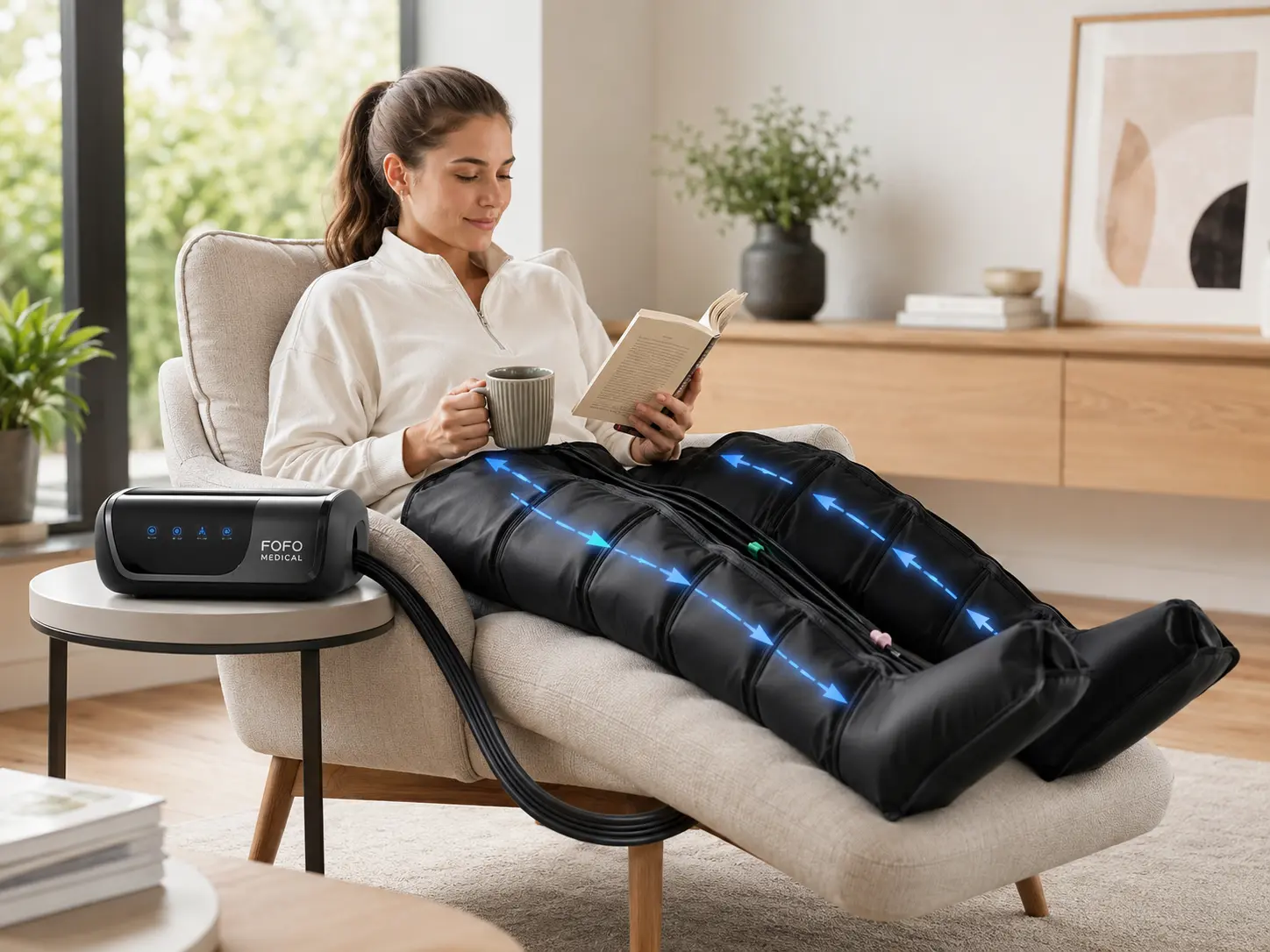
A home-care scene showing air compression therapy for lower limb edema, circulation support, and recovery comfort.
What Is Lower Limb Edema and Why Does It Matter for Recovery Care?
Lower limb edema refers to swelling in the legs, ankles, or feet caused by fluid accumulation in the tissue. It may occur after surgery, during long periods of sitting or standing, in elderly-care settings, during recovery programs, or in users with circulation-related concerns. In many real-world care environments, the goal is not only to reduce visible swelling but also to support comfort, mobility, and daily recovery routines.
For hospitals and rehabilitation centers, lower limb edema care is often part of broader post-surgery recovery, mobility support, or circulation management. For elderly-care providers, it may be connected with reduced movement and long sitting periods. For wellness and home-care channels, users often describe the need more simply: heavy legs, tired calves, swollen ankles, discomfort after standing, or slow recovery after exercise.
This is why lower-limb air compression therapy has strong market potential. It connects medical recovery, home care, elderly care, sports recovery, and daily comfort. For suppliers and distributors, that means one product category can serve multiple sales channels if it is positioned correctly.
How Air Compression Therapy Supports Lower Limb Edema Care
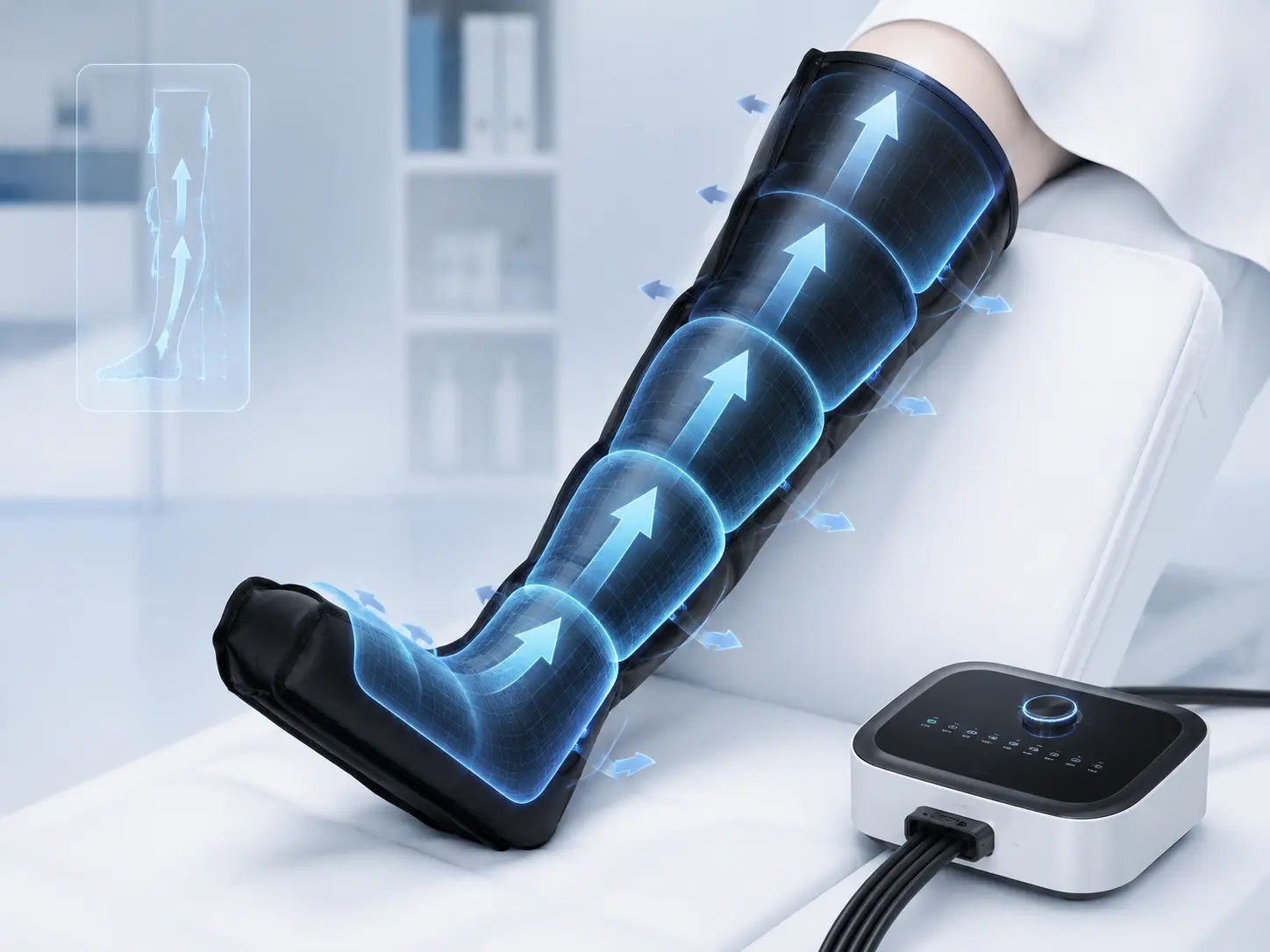
Sequential compression therapy applies controlled air pressure from the lower leg upward to support circulation and edema-care routines.
Air compression therapy uses inflatable chambers inside leg sleeves or boots to apply gentle, controlled pressure to the lower limbs. In a sequential compression system, the chambers typically inflate from the distal area, such as the foot or ankle, and move upward toward the calf or thigh. This pattern is designed to support venous return and lymphatic flow, helping move fluid more efficiently through the lower limb.
Unlike static compression stockings, air compression therapy provides an active compression cycle. The device inflates, compresses, releases, and repeats. This repeated action can help support circulation and comfort during recovery-care sessions. It may also provide a more user-friendly option for people who find traditional compression garments difficult to wear.
| Compression Stage | What Happens | Why It Matters for Buyers |
|---|---|---|
| Sequential Inflation | Air chambers inflate from the foot or ankle upward. | Supports directional compression and improves user confidence in the therapy process. |
| Controlled Compression | Gentle pressure is applied to the lower limb. | Helps support circulation, fluid movement, and comfort during recovery sessions. |
| Pressure Release | The air chambers deflate after each compression cycle. | Improves comfort and avoids constant pressure on the same area. |
| Cycle Repetition | Inflation and release repeat according to selected modes. | Provides consistent sessions for clinics, home-care users, and recovery centers. |
For medical device buyers, the important point is consistency. A lower-limb compression system must provide stable pressure, comfortable sleeve coverage, reliable connectors, and easy control. If the compression feels uneven or the sleeve is difficult to wear, the user experience drops quickly. In B2B sales, bad comfort becomes bad feedback. Bad feedback becomes returns. Returns become headaches. And nobody imports headaches on purpose.
Who May Need Lower Limb Air Compression Therapy?
Lower limb air compression therapy is commonly used in recovery-support, circulation-support, and comfort-care environments. It can be suitable for users who experience leg swelling, calf fatigue, poor lower-limb comfort, post-surgery recovery needs, prolonged sitting or standing discomfort, sports recovery demands, or general leg relaxation needs.
However, it should not be presented as a universal treatment or a replacement for professional medical care. Users with diagnosed vascular conditions, heart problems, blood clot risk, severe swelling, skin wounds, or other medical concerns should consult a qualified healthcare professional before use. This is especially important for distributors and online sellers. Responsible wording protects the user, the supplier, and the sales channel.
| User Scenario | Common Need | Suitable Product Direction |
|---|---|---|
| Post-surgery recovery support | Leg circulation support and swelling-management support | Medical-positioned lower limb compression therapy system |
| Elderly-care facilities | Comfortable daily leg care and easy operation | Simple-control air compression leg massager boots |
| Long sitting or standing | Leg heaviness, tired calves, ankle swelling support | Home-care or wellness leg compression device |
| Sports recovery | Muscle comfort and post-training recovery support | Compression boots with adjustable modes and levels |
| Daily relaxation | Comfort, warmth, fatigue relief, user-friendly experience | Leg massager with heating or comfort-focused model |
Air Compression Leg Massager Boots: Why They Are Popular for Lower Limb Edema Care
Boot-style lower-limb compression devices are popular because they are easy to understand and easy to use. Users can place their legs inside the boots, select a mode, and begin a compression session. Compared with smaller cuffs, full-leg or calf-covering boots can provide broader coverage and a more complete lower-limb experience.
For distributors and rehabilitation equipment buyers, air compression leg massager boots are often a strong product category because they serve multiple market needs. They can be promoted for recovery care, lower-limb circulation support, edema-care support, elderly-care comfort, and post-activity relaxation, depending on product classification and local regulatory rules.
The strongest selling point is not only the compression itself. It is the combination of sequential compression, easy operation, visible product value, and broad user demand. A buyer can demonstrate the product in a clinic, recovery center, showroom, or online product video without a long technical explanation. If a product is easy to understand, it is easier to sell. Simple truth, expensive lesson.
Lower Limb Compression Device vs Regular Leg Massager
Many buyers confuse lower-limb compression therapy devices with ordinary leg massagers. The two categories may look similar, but their market positioning can be very different. A lower-limb compression therapy device is usually designed around controlled air pressure, sequential compression, sleeve coverage, and recovery support. A regular leg massager may focus more on relaxation, comfort, warmth, or consumer wellness.
This difference matters when writing product pages, creating ads, and preparing registration documents. If a comfort product is marketed with medical claims, it may create compliance risk. If a medical-positioned product is described too casually, it may lose trust with hospitals and professional buyers.
| Comparison Point | Lower Limb Compression Therapy Device | Regular Leg Massager |
|---|---|---|
| Primary Positioning | Recovery support, circulation support, edema-care support | Relaxation, daily comfort, fatigue relief |
| Compression Logic | Sequential air chamber inflation and release | May use air compression, vibration, heat, or simple massage modes |
| Buyer Channel | Hospitals, rehabilitation centers, medical distributors, elderly-care providers | Retail, e-commerce, wellness stores, home relaxation channels |
| Documentation Need | Often requires stronger certificates, testing reports, and registration support | May require lower-level consumer product documentation depending on market |
| Marketing Risk | Must avoid unsupported treatment claims | Should avoid being presented as a medical treatment device without proper support |
How to Choose the Right Air Compression Therapy Device for Lower Limb Edema
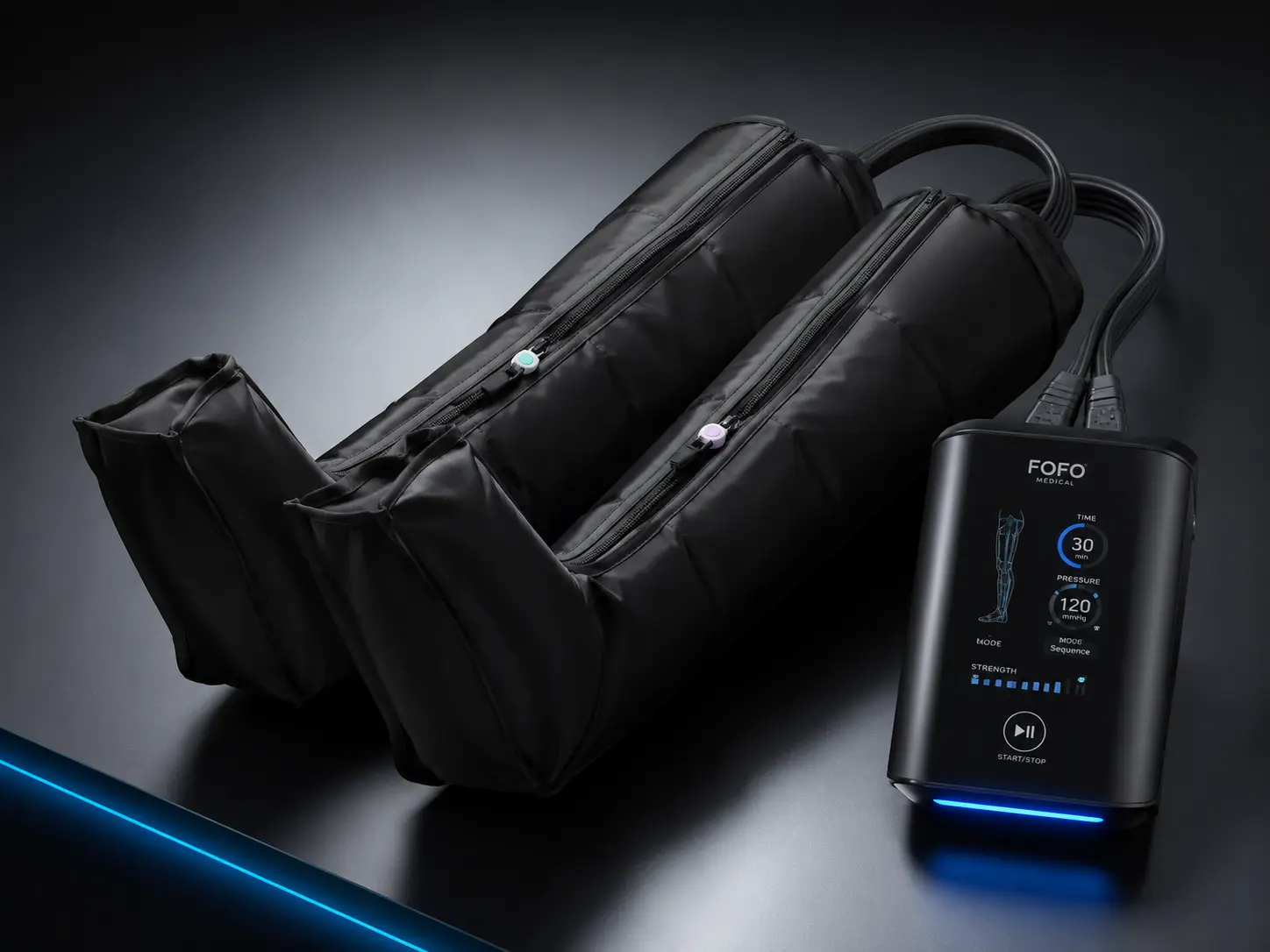
FOFO lower-limb air compression therapy device with compression boots, air hoses, and smart controller for recovery-care applications.
Choosing the right lower-limb compression therapy device starts with the buyer’s market. A hospital buyer, a rehabilitation distributor, a home-care brand, and an online wellness retailer do not need the same product positioning. They may all sell leg compression devices, but they sell to different expectations.
If your target customers are hospitals or rehabilitation centers, prioritize medical certification, stable pressure control, durable construction, and clear operation. If your target customers are home-care users, prioritize comfort, easy wearing, lightweight handling, and simple settings. If your target market is online wellness retail, a product such as an air compression leg massager with heating may be easier to explain because warmth adds an immediate comfort benefit.
| If Your Market Is… | Choose This Product Direction | Why It Works |
|---|---|---|
| Hospitals and rehabilitation centers | Certified air compression therapy system | Professional buyers require documentation, pressure reliability, and durable use. |
| Home-care distributors | Wireless or battery-operated compression device | Convenience improves user acceptance and repeat use. |
| Wellness and relaxation retailers | Leg massager for comfort and relaxation | Easier to sell as a daily comfort product without heavy medical education. |
| Sports recovery centers | Adjustable compression boots with multiple modes | Different users need different intensity and recovery routines. |
| Elderly-care facilities | Easy-use, comfortable, low-noise leg compression system | Comfort and operation simplicity reduce staff workload and user resistance. |
Common Mistakes Buyers Make When Sourcing Lower Limb Compression Devices
The first common mistake is choosing only by price. Low price may look attractive during quotation comparison, but it can hide weak materials, unstable pressure, poor connectors, short product life, or missing documentation. For distributors, these problems usually appear after shipment, not before payment. That is the worst timing.
The second mistake is ignoring sleeve coverage and sizing. Lower-limb users may have different calf sizes, thigh sizes, mobility levels, and comfort expectations. If the sleeve fit is poor, the device may feel uncomfortable or ineffective. A good supplier should provide clear product size information and practical selection support.
The third mistake is overlooking noise level and ease of use. In home-care and elderly-care environments, a loud or complicated device may not be used consistently. A user-friendly control interface, comfortable sleeve material, and low-noise operation can improve actual product value.
The fourth mistake is making unsupported medical claims. It is safer and more professional to use phrases such as “supports circulation,” “helps manage swelling,” “designed for recovery care,” or “assists comfort during lower-limb care.” Avoid claims such as “cures edema” or “guarantees recovery.” Those words may sound powerful, but they can punch your compliance strategy in the face.
The fifth mistake is not checking certification documents early. Buyers should ask about CE/MDR, FDA 510(k), ISO 13485, NRTL, MHRA, IEC60601, EMC, ISO10993, and other relevant documents before confirming the order. Documentation should be part of the sourcing conversation, not an emergency request after customs or registration problems appear.
FOFO Medical Lower Limb Air Compression Therapy Solutions
FOFO Medical provides multiple air compression therapy and leg recovery-care product options for different market needs. Buyers can select models according to medical positioning, home-care convenience, wellness comfort, heating function, battery operation, and distribution channel.
Air Compression Leg Massager Boots
The air compression leg massager boots are suitable for lower-limb circulation support, edema-care support, post-activity recovery, and leg comfort. They are easy to understand, suitable for product demonstrations, and practical for distributors targeting clinics, elderly-care providers, home-care users, and wellness markets.
Air Compression Leg Massager with Heating
The air compression leg massager with heating combines air compression with warmth for added comfort. This type is especially suitable for home-care, relaxation, elderly-care, and wellness distribution channels where user comfort is a major selling point.
Wireless Battery Operated Air Compression Device
The wireless battery operated air compression device is suitable for buyers who want greater mobility and fewer cable restrictions. It can support home-care users, bedside recovery, and flexible use environments where simple operation is important.
Lithium Battery Air Compression Therapy System
The lithium battery air compression therapy system is designed for portable use. Battery-powered operation may help improve convenience in home-care, rehabilitation, and flexible recovery settings.
Leg Massager for Relaxation and Comfort
The leg massager for relaxation and comfort is suitable for distributors targeting daily wellness and relaxation channels. This product direction is easier to position for users who want comfort after standing, sitting, traveling, or exercising.
Certification and Compliance Support for International Buyers
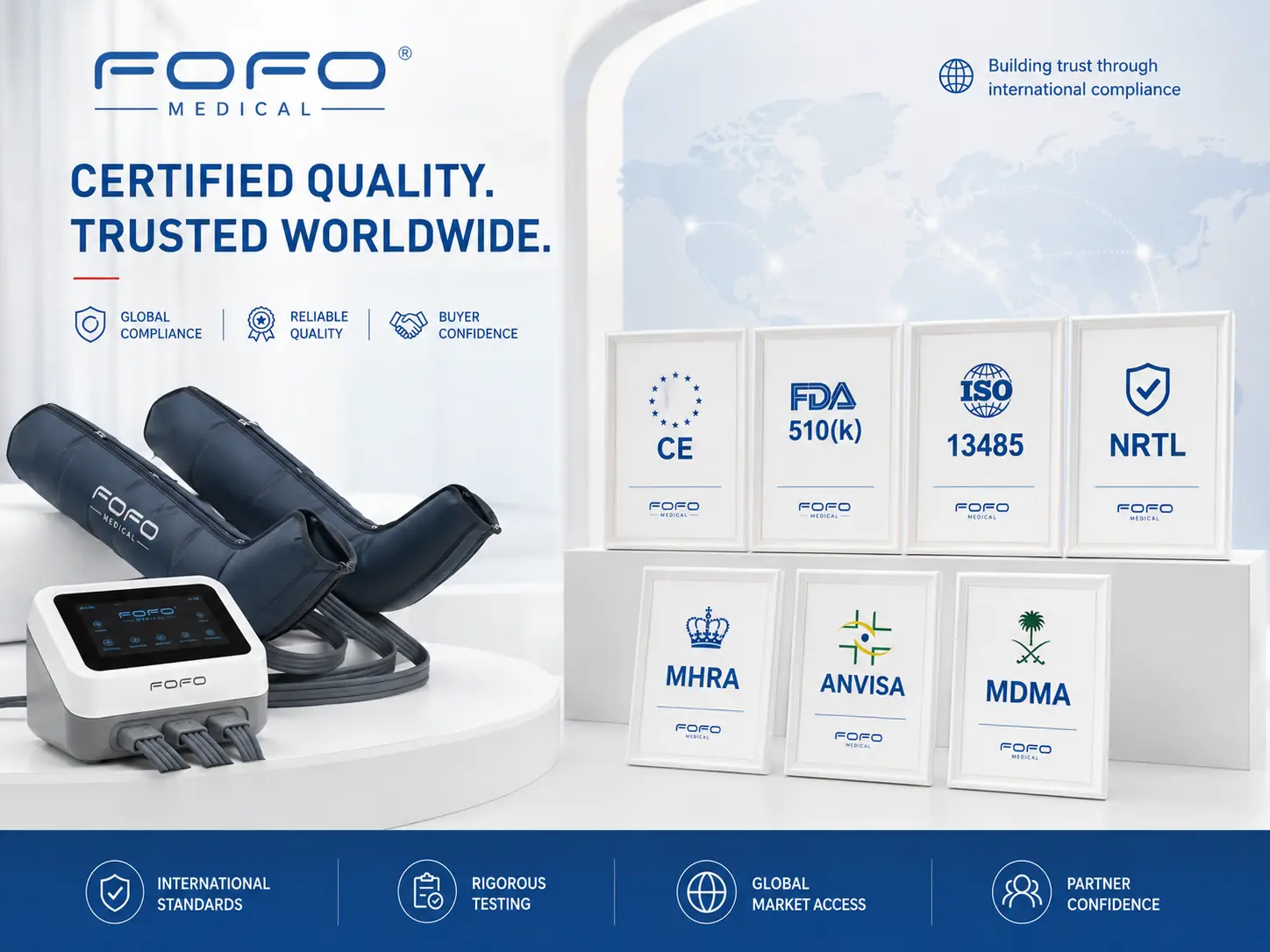
FOFO Medical supports international buyers with certification and compliance documentation for air compression therapy products.
For lower-limb air compression therapy products, compliance support is a major part of B2B trust. FOFO Medical supports international buyers with a strong certification and testing foundation. FOFO major products are registered under MDR Regulation (EU) 2017/745 through its EC Representative, MedNet EC-REP GmbH. FOFO air compression therapy systems and nebulizers have obtained FDA 510(k) clearance since 2019, while mattresses, cushions, massagers, and related products have also been registered with FDA since 2016.
FOFO also maintains ISO 13485:2016 quality management system registration for medical devices. Additional support includes CFDA registration for selected medical products in China, FSC for export, SGS-issued NRTL certificates for the U.S. and Canadian markets, MHRA registration in the UK, ANVISA registration support for Brazil customers, SFDA registration support for Saudi Arabia, and testing reports such as IEC60601, EMC, LVD, REACH, RoHS, WEEE, POP, PRO65, ISO10993, and FCC.
For importers and distributors, these documents can help reduce communication friction during local registration, distributor review, hospital procurement evaluation, and market entry preparation. In medical device sourcing, certificates are not “nice extras.” They are the bridge between a product sample and a sellable product.
FAQ
1. What is air compression therapy for lower limb edema?
Air compression therapy for lower limb edema uses inflatable leg sleeves or boots to apply controlled pressure to the legs. The sequential compression cycle helps support circulation, lymphatic movement, swelling management, and recovery comfort when used according to product instructions and professional guidance.
2. How does sequential compression help the lower limbs?
Sequential compression inflates air chambers from the foot or ankle upward toward the calf or thigh. This directional pressure pattern is designed to support venous return and lymphatic movement, helping the lower limbs feel more comfortable during recovery-care sessions.
3. Who can use lower limb air compression therapy devices?
Lower limb air compression therapy devices may be used by people seeking leg circulation support, swelling-management support, post-activity recovery, daily comfort, or home-care convenience. Users with medical conditions should consult a qualified healthcare professional before using the device.
4. Are air compression leg massager boots suitable for home care?
Yes, many air compression leg massager boots are suitable for home-care use when they are easy to wear, simple to operate, comfortable, and supported by reliable safety documentation. Wireless or battery-operated models may provide better convenience for home users.
5. What should B2B buyers check before sourcing lower limb compression devices?
B2B buyers should check pressure control, sleeve size, compression mode, material comfort, noise level, controller design, spare parts support, certification documents, and local registration requirements before sourcing lower limb compression devices.
6. What is the difference between air compression therapy and a normal leg massager?
Air compression therapy usually focuses on controlled sequential compression for circulation support and recovery care, while a normal leg massager may focus more on relaxation and comfort. Buyers should avoid making unsupported medical claims for comfort-focused products.
7. Why are certifications important for air compression therapy products?
Certifications and testing reports help buyers evaluate product safety, regulatory readiness, and market access. Documents such as CE/MDR, FDA 510(k), ISO 13485, NRTL, MHRA, IEC60601, EMC, and ISO10993 can support distributor confidence and local registration work.
8. Why choose FOFO Medical for lower limb air compression therapy products?
FOFO Medical provides lower limb air compression therapy and leg massager solutions with certification and testing support for international buyers. Its documentation support includes CE/MDR, FDA 510(k), ISO 13485:2016, NRTL, MHRA, CFDA, FSC, ANVISA support, MDMA/SFDA, and multiple testing reports.
Final Recommendation
Air compression therapy for lower limb edema is a practical product category for hospitals, rehabilitation centers, elderly-care providers, home-care distributors, and wellness channels. Professional buyers should choose lower-limb compression devices based on user scenario, compression mode, sleeve coverage, pressure control, comfort, certification documents, and after-sales support. FOFO Medical offers air compression leg massager boots, heating compression models, wireless battery-operated devices, and lithium battery compression therapy systems to support different recovery-care and distribution needs.
For buyers planning to source lower-limb air compression therapy products, the safest next step is to compare product positioning, certification documents, target market requirements, sleeve design, pressure settings, and user comfort before confirming an order. FOFO Medical can help distributors and medical device buyers select suitable lower-limb compression therapy solutions for clinical, home-care, elderly-care, and wellness markets.
Previous News
What Is Air Compression Therapy? A Practical Gu...Next News
Air Compression Leg Massager Boots: How to Choo...Feature Product
-
 Portable Phlegm Suction Machine Vacuum Aspirato...
Electric Suction Machine for Home Care Qu...
-
Portable Electric Phlegm Suction Machine FO9001-E
Electric Emergency Portable Suction Machi...
-
Cute Pig Nebulizer for Baby Asthma Relief Home ...
Kids Cute Pig Shape Compressor Nebulizer, Porta...